
Key points to put on a Spec sheet
If you’re new to this blog, or lingerie design itself, you may wonder what a specification sheet is or if you need one for your lingerie designs. And whilst I have written about “how to spec a bra and brief” and drafted out templates so you can draft your own ones out, if you haven’t seen these , or want to know how important a spec sheet is then you need to know the following.
A specification sheet is a detailed sheet, with all the important measurements of your garment with it’s base size and all the other sizes you wish to produce. As well as standard information like your company name and style number/name of your garment, it will have a technical drawing with reference points to garment.
For example if you were to spec up a brief, you would have the measurement of the medium waist say for example 30cm then you would list the waist measurement of all the other sizes. So small would be 27.5cm and large would be 32.5cm (going on the grade of 2.5cm on the half).
If you need your lingerie graded, some graders won’t need a a spec sheet to work from and will just apply standard grades, and can produce the spec sheet for you .
It’s a bit like the chicken and egg, in which comes first, the grade or the spec. To write a spec sheet, you need to know how much everything grades by, but to get your lingerie graded you need to take the information off the spec sheet.
Some graders will be able to do your spec sheet for you, but some will want to work off your spec sheet. So it’s a balance of finding what works well for you.
When it comes to briefs I usually start with approximately eleven measurements :
And after that it would be extra measurements if you have more detail or seams on the brief, for example if you’ve a brief with a top part of fabric and a lower part then you would need both these measurements.
On a bra I usually have the minimum of twenty measurements, but depending on the bra style only 15+ may get used, These include, top of cup, through the cup - going through the fullest part of the bust, the length of the wing - relaxed and stretched. For a more detailed list of all the measurements, they are listed in the book “How to spec a bra and brief”
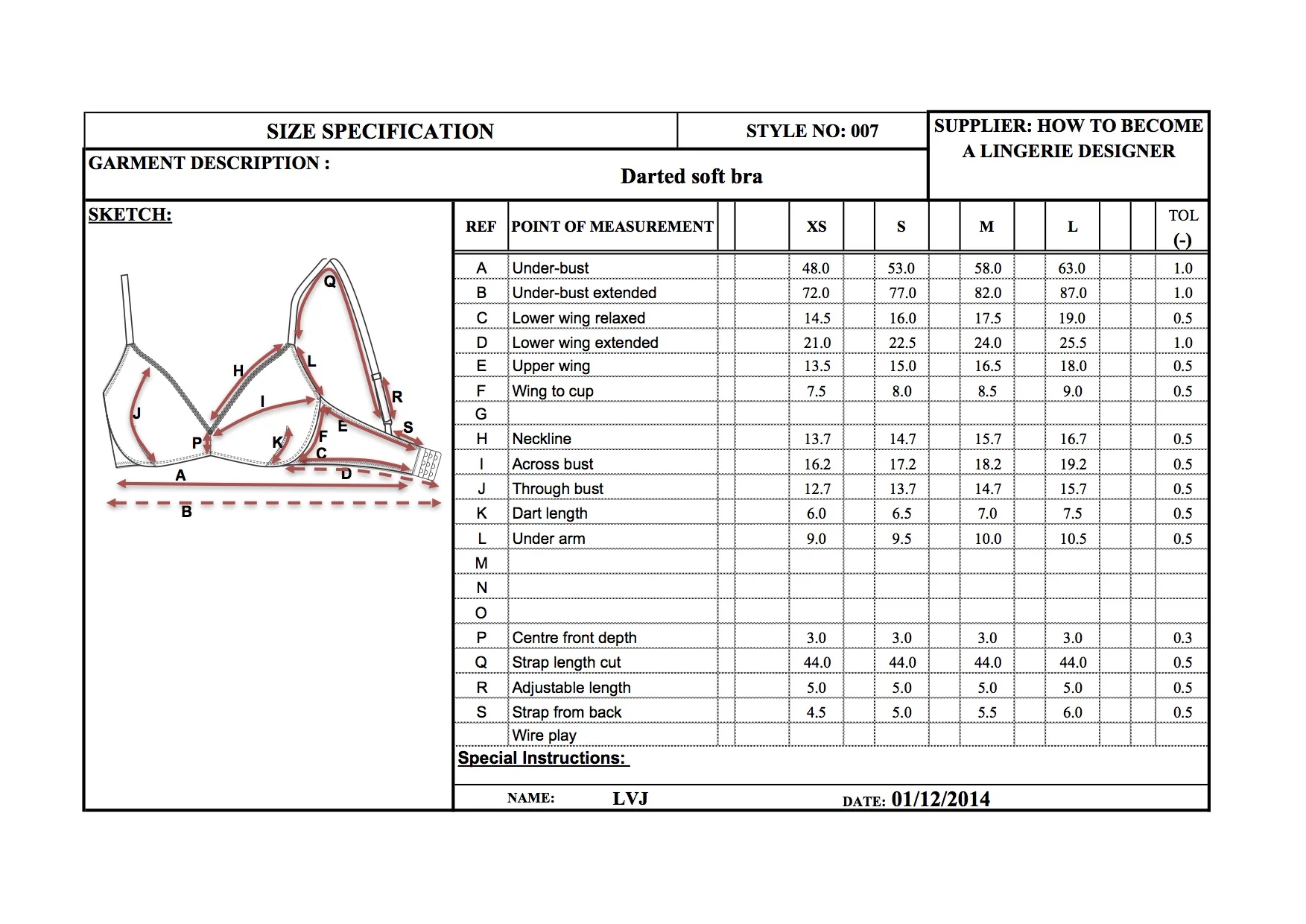
Not only do pattern makers and graders follow your spec, so do quality controllers, when you receive your sample or your range back from the lingerie manufacturers, the lingerie spec will be what you measure your lingerie by, ensuring all the lingerie manufactured are within tolerance (a measuring discrepancy given to all make-up of garments) before they can be sold.
WHAT TO PUT ON THE SPEC SHEET
So the key points to put on your lingerie spec sheet, are the following:
Company name
Style number or name
Garment description
Date
Technical drawing of your lingerie including references and arrows)
POM (Point Of Measurement correlating to your reference points)
Sizes
Tolerance each POM has
There are many different layouts of spec sheets, I tend to stick with my tried and tested spec sheet, which lay out has been used by factories. If you are wanting just a layout of a spec sheet to use, then your get the design sheet of the spec sheet here.
To write your own spec sheet help is below:
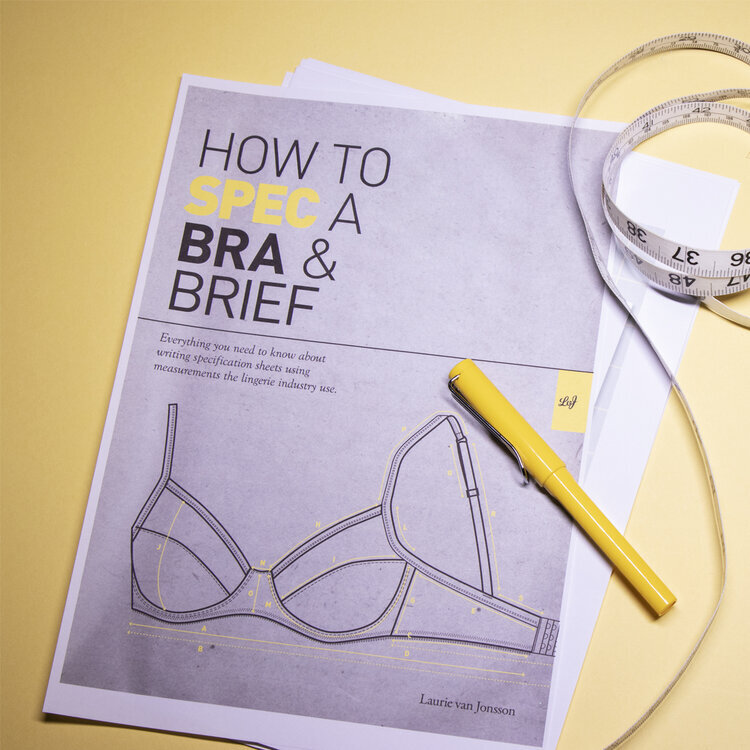
Master the Art of Lingerie Spec Sheets—No Guesswork, No Stress!
Ready to turn your lingerie designs into factory-ready masterpieces? This book is your ultimate guide to writing a professional lingerie specification sheet—without the overwhelm.
With clear step-by-step instructions, diagrams, and industry-approved grading rules, you'll confidently create spec sheets that ensure every stitch, seam, and strap is just right. No more guessing, no more endless Googling.
Inside, you'll learn:
Exactly where to measure bras and briefs for accurate sizing
Key measurements and grading increments used in the industry
You need a Spec sheet to calculate fabric and trim usage to avoid costly mistakes
A well-crafted spec sheet is your secret weapon for smooth production—whether you're working with a factory or sewing your own designs. Plus, you're free to replicate the included spec sheets and start using them immediately.
Don’t let unclear specs hold your designs back. Grab this book now and take the first step toward pro-level lingerie production!